
Launching a card program is no longer the exclusive domain of banks. Today, fintechs, digital wallets, crypto platforms, and companies across many other sectors can issue payment cards through a range of models.
And one of the first strategic decisions is exactly that, choosing the right model. Do you launch on a Shared BIN? Do you invest in a Dedicated BIN? Or do you pursue your own Dedicated ICA?
The answer doesn't necessarily come down to which model is "best," but to your company's stage, your business objectives, and your long-term growth strategy. In this guide we break down how each model works, its advantages and trade-offs, and when it makes sense to move from one to the next.
What sets each issuing model apart
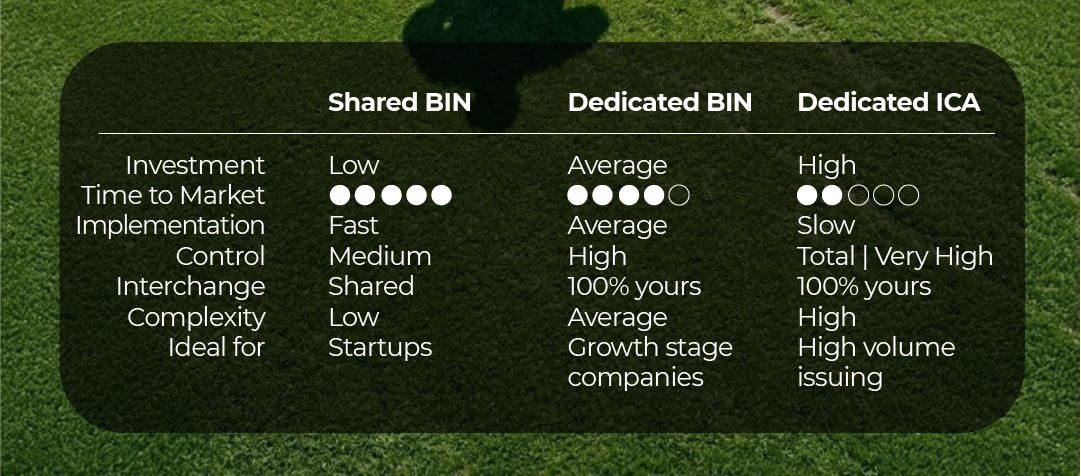
While all three allow you to issue cards, they differ on one key dimension: how much ownership, control, and liability you take on. Rather than competing options, it helps to see them as stages in a program's growth. Many companies start with one and graduate to the next as they scale.
Shared BIN: the fastest way to launch
With a Shared BIN, multiple programs operate under the same BIN held by a sponsor institution (often called a BIN Sponsor). It carries the lowest upfront investment and the shortest implementation timeline, making it ideal for getting to market fast and validating your product.
Best for: startups, boutique and mid-sized financial institutions, MVP launches, pilot programs, and first-time issuers.
You gain speed, lower costs, and access to network-compliant infrastructure that is already managed for you. In exchange, because the BIN is shared, customization and flexibility are more limited than in the dedicated models.
Dedicated BIN: more control as you scale
As a program grows, it typically needs more flexibility, brand identity, and operational control. With a Dedicated BIN, the sponsor assigns a BIN exclusive to your program while continuing to backstop network compliance. It is the middle ground between independence and simplicity.
Best for: fintechs at scale, established payment programs, and companies seeking greater customization.
You gain greater program control, stronger branding opportunities, and more operational flexibility. In exchange, implementation costs are higher and you need enough transaction volume to justify the investment.
Dedicated ICA: your own membership and maximum independence
A Dedicated ICA (Interbank Card Association) gives you direct visibility with Mastercard and, with it, the highest level of independence. In exchange, you take on greater network, governance, and operational responsibility.
Best for: large-scale issuers, mature fintechs, and organizations with high issuing volumes pursuing long-term independence.
You gain maximum operational control, a direct relationship with the network, and strategic autonomy. In exchange, it requires significant investment and experienced teams to sustain direct network participation.
So, which one is right for me?
Instead of asking which model is best, ask yourself: how fast do I need to launch? How much operational control do I require? What transaction volume do I expect? Am I prioritizing speed today or independence tomorrow?
For many companies the path is progressive: they start on a Shared BIN, move to a Dedicated BIN once the program scales, and reach a Dedicated ICA at enterprise maturity. Not every company follows this route, but for most it is a practical roadmap for growing sustainably.
Decision framework
| Business stage | Recommended model |
|---|---|
| New product / MVP | Shared BIN |
| Program at scale | Dedicated BIN |
| Issuer with annual volumes above $50M | Dedicated ICA |
Key takeaways
- All three models allow you to issue cards, but with different levels of control, investment, and liability.
- The Shared BIN prioritizes speed and simplicity.
- The Dedicated BIN balances flexibility with network compliance backing.
- The Dedicated ICA is built for issuers pursuing long-term independence.
- The best model depends on your business stage; there is no single right answer.