Less than a couple of seconds pass between "tap your card" and "Approved." What gets decided in that instant determines how much balance you are left with from then on.

Launching a card program means deciding where the money comes from every time someone pays. It sounds like a technical detail, but it defines something that matters a great deal: how much capital you have sitting idle, earning nothing. And you don't need to be a payment-network expert to decide with good judgment. At its core there are only three answers: the money arrives ahead of time, at the exact moment, or on credit. Each one is a different model, and in this article we look at which one fits your product.
What happens in those seconds
When the user taps their card, not much seems to happen: "Approved" shows up almost instantly. Under the hood, though, a rapid back-and-forth kicks off. The merchant sends the authorization to its acquirer, the acquirer passes it to the network (e.g., Mastercard), the network routes it to your processor, and the response — approve or decline — travels back to the point of sale. All of it inside a strict end-to-end window the networks enforce; a well-built program responds in milliseconds.
Here it is worth clearing up something that gets confused all the time: authorizing is not collecting. An authorization only reserves the amount — a "hold" — and moves no money. The actual movement, settlement, happens later, usually the next day, when the network runs its cutoff. Having a balance and having been paid are two different things, and a good part of this decision plays out in the gap between the two.
Prefunded: the money, ahead of time
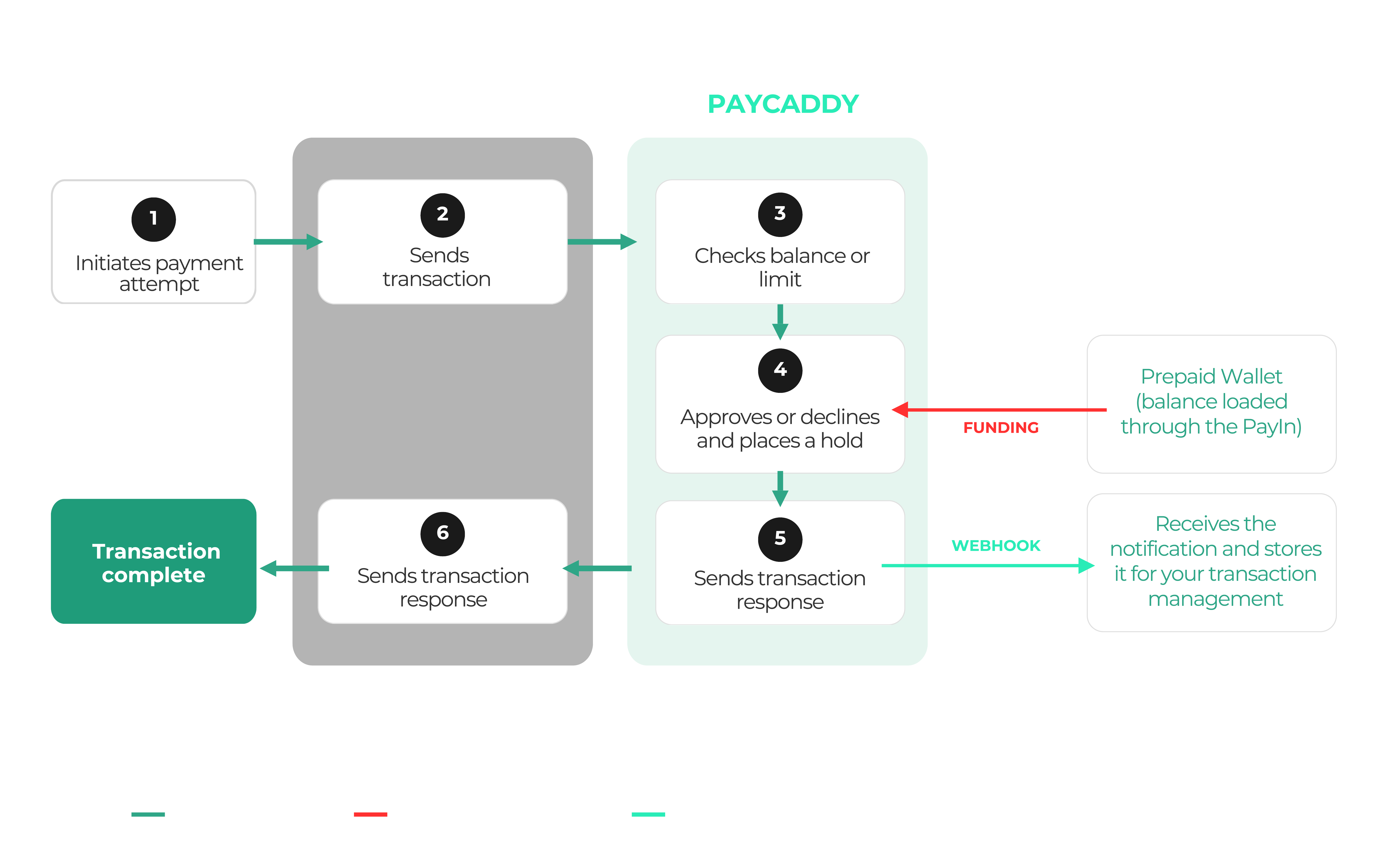
Here, funds are deposited in advance into a pooled account or trust tied to the issuer. Each user's balance lives inside that account as part of the pool, the processor keeps the record of who holds what, authorization becomes a simple check for available funds, and settlement is drawn against that same pre-deposited balance.
Its appeal is simplicity. It doesn't require infrastructure of your own making real-time decisions, so launch is faster, and since the money is there before it gets spent, settlement risk is low. The price is capital. Deposited funds typically earn nothing while they wait to be spent, and if the aggregate balance runs dry, authorizations get declined even if your business is perfectly solvent. It is the natural model for prepaid cards, gift cards, and benefits programs, where getting to market fast matters more than squeezing every last dollar of capital.
JIT: the money, at the exact moment
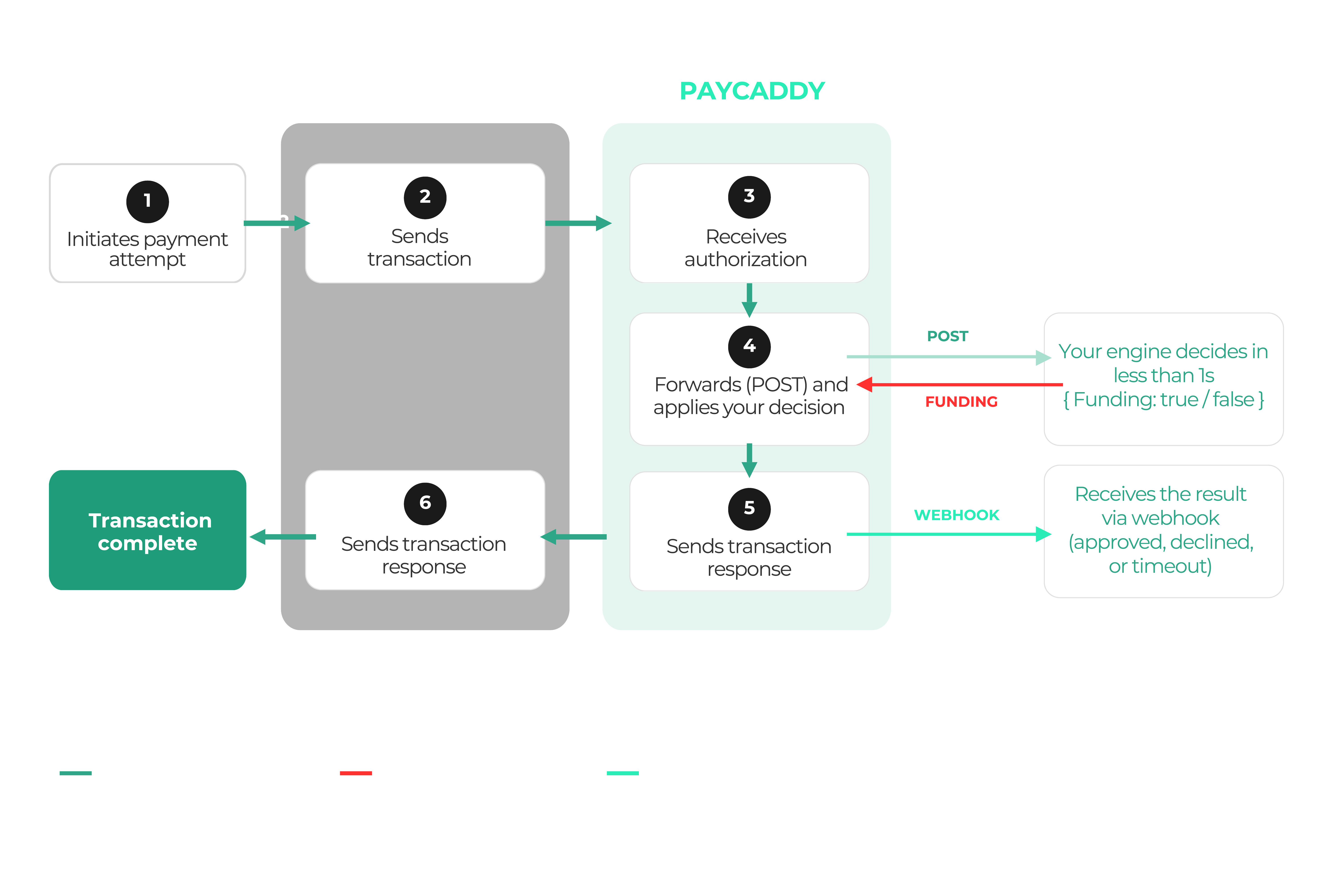
In the JIT model, the card can sit at zero right up to the instant of the transaction. Funds are released in real time, precisely when the network requests authorization, and the backing stays in your treasury or another account until the last second. Instead of all the money made available in wallets sleeping in a trust, you only post a dynamic guarantee and keep the rest of your money working until the moment it is needed. And since every authorization runs through your rules, you decide on the spot what gets approved and what doesn't, against your ledger, your limits, and your anti-fraud logic.
In exchange, JIT gives you what prefunding can't: less parked money, fine-grained control over every expense, fraud validation against the context of each transaction, and the freedom to choose where the money comes from. The price is technical demand. You have to respond within the window, never debit the same transaction twice, and reconcile every authorization against your ledger afterward. It is the most common model for banks looking to issue on debit rails, and for USD cards funded from digital-asset accounts.
Credit: the money, on credit
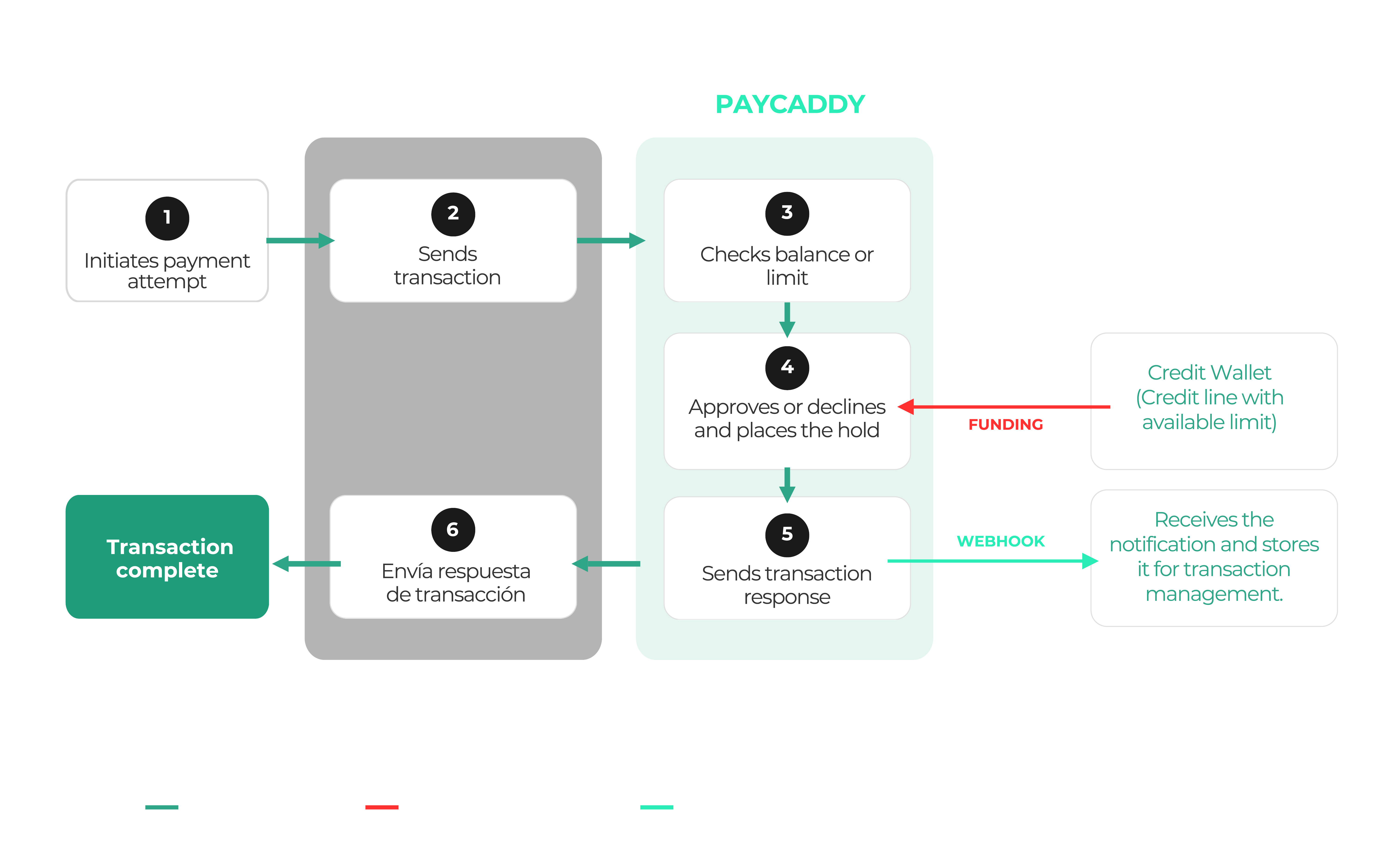
Credit goes one step further: the program authorizes and settles against a credit line or a disbursement you have extended. Like the previous flow, it runs on a dynamic guarantee, so capital efficiency is high. The cost is risk, because you are exposed between authorization and settlement. You also need to weigh your country's regulations on extending credit; they can be a dealbreaker for this flow.
For the program to grow well, follow credit-risk best practices: work with people who have a solid credit history, ask for collateral, and don't extend credit to just any profile. It is the model behind credit cards and lending, and the far end of a spectrum that starts with prefunding (the money ahead of time), runs through JIT (at the moment), and ends here (on credit).
How to choose without overthinking it
It all comes down to a few questions. The most important one is what idle capital costs you. A million dollars prefunded, at a 10% annual cost of capital, is a hundred thousand dollars a year earning nothing. That is the salary of a couple of engineers, or a quarter's worth of marketing. The more volume you move, or the more expensive your source of funds, the stronger the incentive not to park the money.
Then comes the technical question: whether your infrastructure can truly respond in real time, because JIT demands it, and without that capability, prefunding reduces your risk. And if credit tempts you, the last questions are how much risk your profile can absorb and whether, from a regulatory standpoint, you are allowed to lend. If the answers point to different models, you don't have to pick just one. You can start with one, test, learn, and then decide whether to add another or migrate.
What changes in LATAM
Two regional factors tip the scales. Dollarization and USD products make JIT attractive for keeping liquidity working, even from digital assets, instead of parking it. And the trust structure behind prefunded programs is well known and supervised by the region's regulators, which keeps it a solid, reliable option for a good share of programs.
Building with PayCaddy
The hard part is not so much choosing the model as building it. Responding within the window, never debiting twice, reconciling every deferred authorization, sustaining compliance and monitoring, being issuer, processor, and BIN sponsor all at once. That is the infrastructure you shouldn't be fighting on your own.
As issuer and processor in one place, with our own BIN sponsorship and regulated by the Superintendency of Banks of Panama, at PayCaddy we help you structure the model you need — whether prefunded, JIT, credit, or hybrid — with network compliance, processing, and monitoring already solved. You decide how your money should flow. We carry the infrastructure. And that is not an abstract promise: Mastercard has recognized us as "Most Agile Enabler" three years in a row at its LAC Innovation Forum for launching programs in record time. You can start with our API if you have a technical team, or go live without writing a single line of code with our Express white-label model.
Frequently asked questions
What is the difference between authorization and settlement? Authorization reserves the amount without moving money. Settlement is the actual movement of funds, and it happens later, usually the next day.
Does JIT eliminate the need to have funds? No. It eliminates the need to deposit them all up front. You operate with a dynamic guarantee.
Can I combine more than one model? Yes. You can start with one, test, learn, and then decide whether to add another or migrate.