Not every company is built the same way. Some have a solid development team and an app ready to scale; others have a great business idea and not a single line of code. Even so, both may want the same thing: to launch their own branded card program.
For a long time, that difference decided who could issue cards and who couldn't. Not anymore. There are two ways to launch an issuing program, designed for the technical reality of each company: Express and Bespoke. At PayCaddy we work with both, and here we explain what each one involves, who it's designed for, and how to know which one best fits your business.
The Foundation: Issuing That Adapts to You
Before Banking as a Service (BaaS), launching a card wasn't within everyone's reach. You had to build the financial infrastructure from scratch or negotiate for months with a bank. It was the domain of large institutions, with ample budgets and technical teams that most companies simply didn't have.
That changed. Thanks to fintech enablers, today almost any company can put its logo on a Mastercard card and open a new revenue stream. But the fact that this barrier no longer exists doesn't mean everyone should issue cards the same way. A fintech with its own developers wants the freedom to build; a retailer or a cooperative that has never written a line of code is looking for speed and simplicity.
That's why we stopped thinking of card issuing as a single product. There are two paths to reach the same result, and you can choose the one that fits your team and your timelines.
Express: Launch Your Program in Days, Not Months
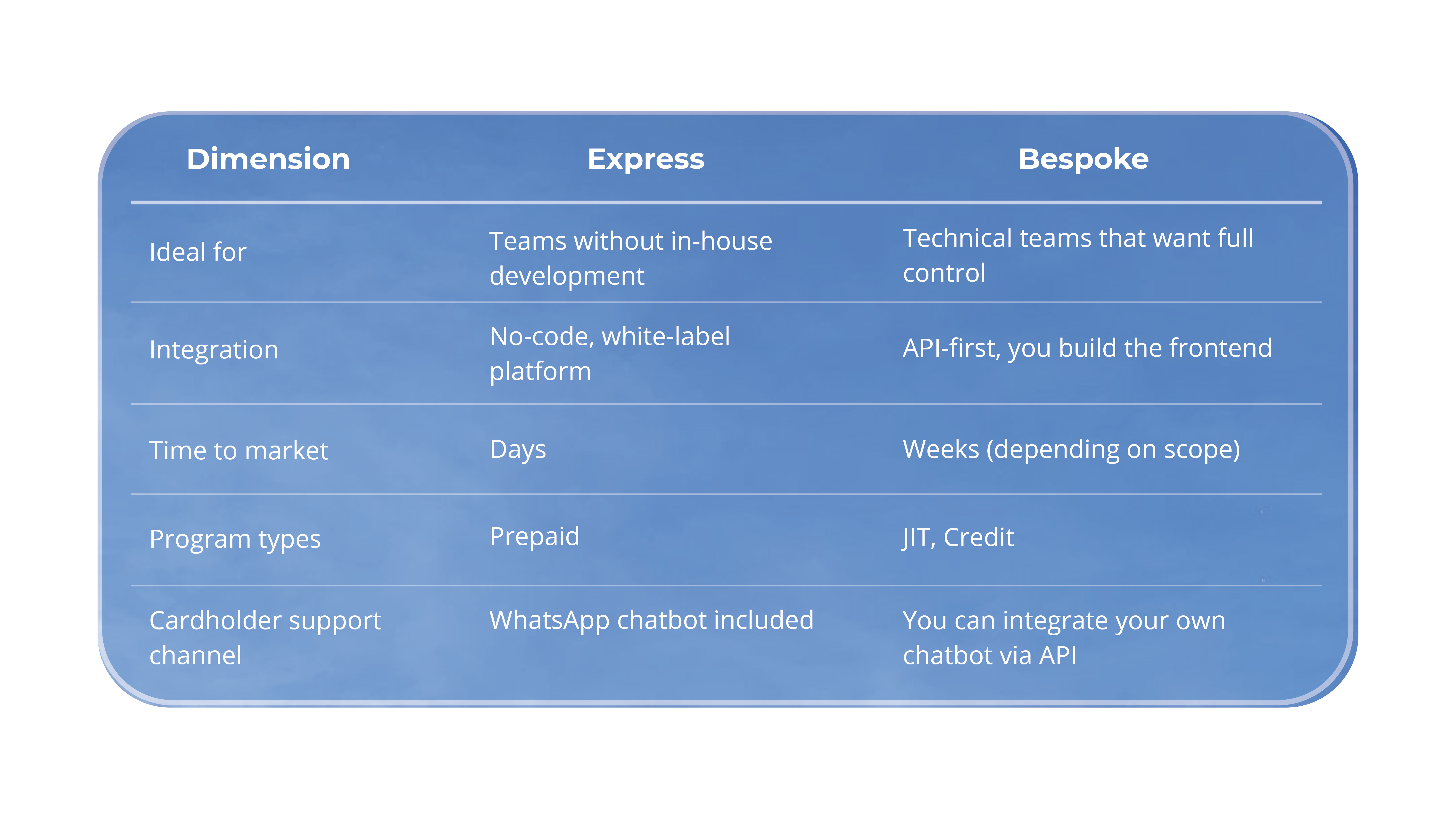
Express is PayCaddy's all-in-one white-label platform: you don't need a development team because the technology, the design, and much of the operation already come solved under your brand.
It includes three pieces. The operational back office is your admin panel: cardholder onboarding and management, card issuing, blocking and replacement, real-time transaction monitoring, and compliance and KYC tools already built in. The branded web app is what your cardholders see, with your logo and your colors, to manage their account, review activity, and control their card from their phone. And there's a channel that many white-label platforms don't offer: a WhatsApp support chatbot, where the cardholder can check their balance, receive transaction alerts, block their card, or change their PIN without leaving the app they already use every day.
With those three pieces already built, launch time is measured in days, not months. Express is available for prepaid card programs and fits banks that want to modernize their offering without touching their core, cooperatives, retailers, HR companies looking to digitize payroll, and any organization with a good card idea that prefers to lean on PayCaddy's expertise and get to market fast, rather than building everything on its own and taking three times as long to do it.
Bespoke: Full Control and Customization, Connected to Our Infrastructure via API
Bespoke goes in the opposite direction: it's PayCaddy's Card as a Service platform, designed for technical teams that want to integrate wallets and cards directly into their own product. You build the frontend; we manage the infrastructure, compliance, and network connectivity behind the scenes. With a well-documented RESTful API, a typical integration takes less than 45 days.
Via API you can implement two types of program, each with its own logic:
- Just in Time (JIT) funding. Authorizes in real time: your system receives the request via webhook, decides whether to approve, and funds the card at the exact moment of purchase. It's the model behind bank debit cards, corporate expenses, or crypto-backed cards.
- Credit. Lets you configure full revolving lines (limits, interest rates, billing cycles) for consumer products, buy now pay later, or business lines.
Getting started is straightforward for a development team: you access sandbox credentials and the documentation, build your integration, go through a security certification process, and go live in production. This program is especially useful for fintechs, neobanks, marketplaces, crypto exchanges, and any digital company that already has its own app and wants cards to feel like a natural extension of its product.
Which Option Will Give You the Support You Need?
The answer has less to do with how big your company is, and more with how much digital maturity you have and what you need to build.
If you don't have a technical team that can integrate and maintain an API, Express takes you to market in days without that requirement. If, on the other hand, you already have that team and the user experience has to be your own, it makes sense to lean toward Bespoke, even if that means weeks of integration instead of days. And if your program needs Just in Time funding, today that piece lives only on the Bespoke side.
And there's a perfectly valid third answer, halfway between the two: start with Express to validate the program quickly and migrate to a Bespoke integration as the operation and the technical team grow. The two options don't compete with each other; they can be two stages of the same process.
A Single Infrastructure
No matter which option you choose, underneath, both run on the same PayCaddy infrastructure, backed by Mastercard's global network. PayCaddy is registered and supervised by the Superintendency of Banks of Panama in matters of anti-money-laundering.
In practice, that translates into virtual cards issued in 24 hours and physical cards in around 30 days, coverage in more than six Latin American countries, and the same security and compliance standard no matter where you enter. Between Express and Bespoke, what changes is how much of the experience you build yourself, but the underlying platform is the same.
In Summary
There is no single right way to launch a card program. Express gives you a no-code path to get to market in days. Bespoke hands you the API to build something made entirely to your measure. Both start from the same engine behind the scenes.
The question you should ask yourself is: which one best describes your company?